
The SMT Line as a Closed-Loop Control System in Electronics Manufacturing
Most explanations of an SMT line follow a simple sequence: print, place, reflow, inspect. It’s a useful starting point, but it doesn’t reflect how the process actually behaves in production. In reality, an SMT line is a connected system where each step influences the next, and small variations can carry all the way through the process. At a Tier-1 level, the focus shifts from running each step well to keeping the entire system stable.

Why “step-by-step optimization” breaks down
The step-by-step view encourages local optimization. Improving paste printing, increasing placement speed, or tightening reflow profiles all sound like progress, but when those decisions are made in isolation, they often introduce instability elsewhere.
A slight variation in paste volume can affect how components sit during placement. Placement variation then shows up during reflow, where it becomes part of the final solder joint. What starts as a small upstream inconsistency can turn into a yield issue downstream, where it’s more difficult and costly to correct.
At a system level, the problem is simple: you are optimizing pieces of a process that only works when everything moves together.
From linear flow to closed-loop control
A more accurate way to think about an SMT line is as a loop rather than a sequence. The process still moves forward physically, but information moves in both directions. Inspection and data systems feed information back into earlier stages, allowing the line to correct itself as conditions change. That feedback is what keeps the process stable over time.
In practice, that loop looks like this:
- Solder paste inspection validates printing and flags variation early
- Placement performance is influenced by those inputs
- Reflow reveals how well the system held together
- Inspection data feeds back into printer settings, placement offsets, and process parameters
Without that loop, defects are simply passed along. With it, they are reduced at the source.
Printing: where variation begins
Solder paste printing plays a larger role than many expect. Even small differences in volume, height, or alignment can influence everything that follows. This is why solder paste inspection (SPI) sits immediately after printing. It measures deposits in three dimensions and highlights issues before components are placed.
In a controlled SMT environment, SPI is not just a checkpoint. It’s part of process control:
- Detects insufficient or excessive paste early
- Identifies alignment drift before it impacts yield
- Enables real-time adjustments to printer settings
Stabilizing printing means stabilizing the entire line.

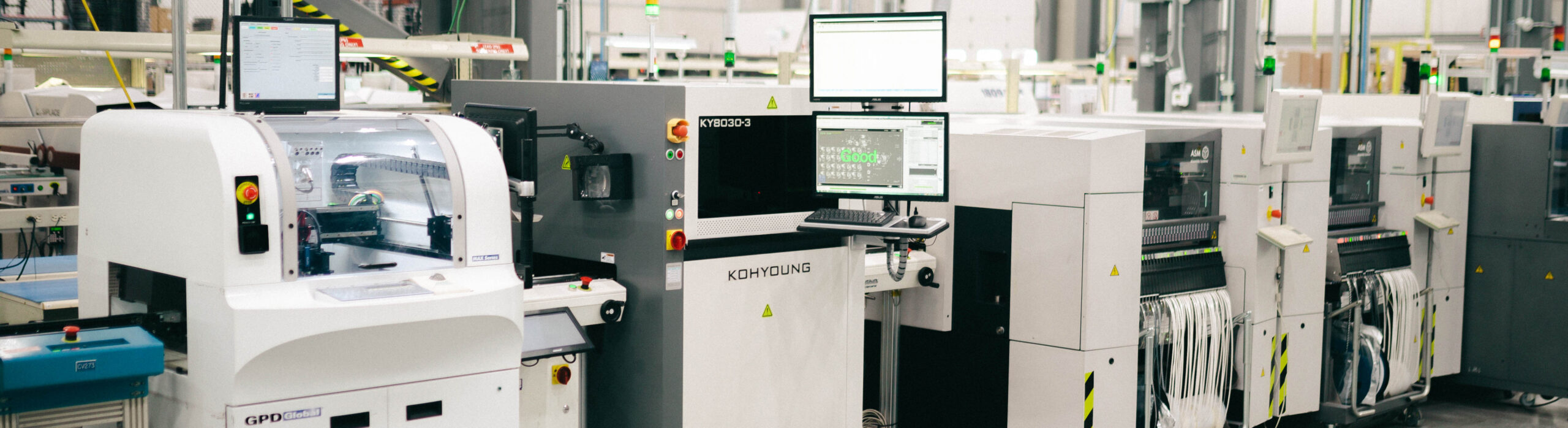
Solder paste printing and inspection at Dynamic Source Manufacturing.
Placement: precision shaped by upstream conditions
Placement is often associated with speed and accuracy, and modern equipment is highly capable on both fronts. DSM’s SMT lines, for example, are designed to handle fine-pitch components and high-density assemblies with precision. At the same time, placement performance is not determined by the machine alone. It depends on:
- Paste consistency and volume
- Board flatness and support
- Component variation and packaging
Reflow can correct small misalignments through self-alignment, but only within limits. If variation is too high, it carries through. That’s why placement is treated as part of a broader system, not as an isolated step.
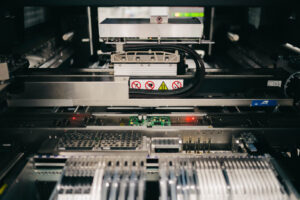
High-speed SMT placement at Dynamic Source Manufacturing, where precision depends on controlled upstream conditions.
Reflow: where the process shows its true quality
Reflow is often described as the final stage, but in practice, it’s where all upstream decisions come together. Thermal profiles must account for board design, component mix, and solder paste behavior. If those inputs are inconsistent, reflow does not correct them, it exposes them.
That’s why reflow development is always tied to upstream conditions. A stable profile depends on a stable process leading into it.
Inspection: from detection to correction
Inspection is where the gap between average and high-performing SMT lines becomes clear. In many setups, it is treated as a checkpoint that identifies defects and routes boards to rework. That approach helps catch problems, but it does little to reduce them.
In a closed-loop system, inspection becomes part of the process itself.
- SPI stabilizes the earliest stage by validating solder paste deposits
- AOI (Automated Optical Inspection) identifies placement and visible solder issues
- X-ray inspection validates hidden joints in complex assemblies like BGAs
The key difference is what happens after detection. Instead of stopping at inspection, the data feeds back into the process. Offsets are corrected, parameters are adjusted, and variation is reduced at its source.
The role of automation, data, and material control
Process stability is not only about what happens on the line. It starts with how materials and data are managed before production even begins. Supporting technologies play a critical role here:
- Smart storage systems that control and track components
- Automated material handling that reduces manual error
- Collaborative robotics for repeatable tasks like dispensing
- MES platforms that connect machines, materials, and inspection data
At DSM, these technologies are integrated into the SMT environment to support consistency, traceability, and repeatability across the process. The goal is not just efficiency, but control.
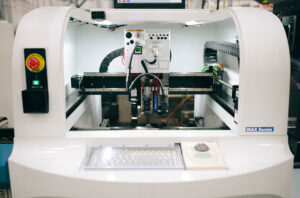
Automated selective soldering at Dynamic Source Manufacturing, supporting consistent and repeatable PCB assembly.
Why system control matters more than equipment specs
Two SMT lines can look nearly identical on paper. They may use similar machines and operate at comparable speeds. The difference shows up in how consistently they perform. A line that operates as a closed-loop system tends to deliver:
- Higher first-pass yield
- Lower rework rates
- More consistent quality over time
- Better long-term product reliability
This is because defects are not just detected, they are actively prevented through continuous feedback and adjustment.
SMT manufacturing is often described in terms of machines and process steps, but performance comes from how everything works together. The most capable lines are not defined by speed or complexity alone, but by how well variation is understood, controlled, and continuously corrected across the entire process.
That is what turns an SMT line into a true system, and it’s the level of control we focus on every day at Dynamic Source Manufacturing.
Reach out today: dsmsales@dynamicsourcemfg.com
Book a facility tour: Contact DSM