

A Complete Guide to the Electronics Manufacturing Process
Every electronic product starts with an idea, but turning that idea into a reliable, production-ready device requires far more than assembling components onto a circuit board. Modern electronics manufacturing combines engineering expertise, advanced automation, rigorous quality control, and efficient supply chain management to deliver consistent, repeatable results at scale.
While every product has unique requirements, most electronic manufacturing services (EMS) providers follow a similar production workflow. Here’s how electronic products move from design files to finished assemblies.

1. Engineering Review & DFM
Every successful build begins with a thorough engineering review. Before production starts, engineers evaluate the customer’s design files, bill of materials (BOM), Gerber data, assembly drawings, and manufacturing requirements.
Design for Manufacturability (DFM) plays a critical role at this stage. Rather than simply building the product as designed, engineers identify opportunities to improve manufacturability without affecting functionality.
Typical DFM reviews include:
- Component spacing and placement
- PCB panelization
- Solderability assessment
- Thermal considerations
- Material availability
- Assembly process optimization
Addressing potential issues early helps reduce production risk, improve yields, and shorten time to market.
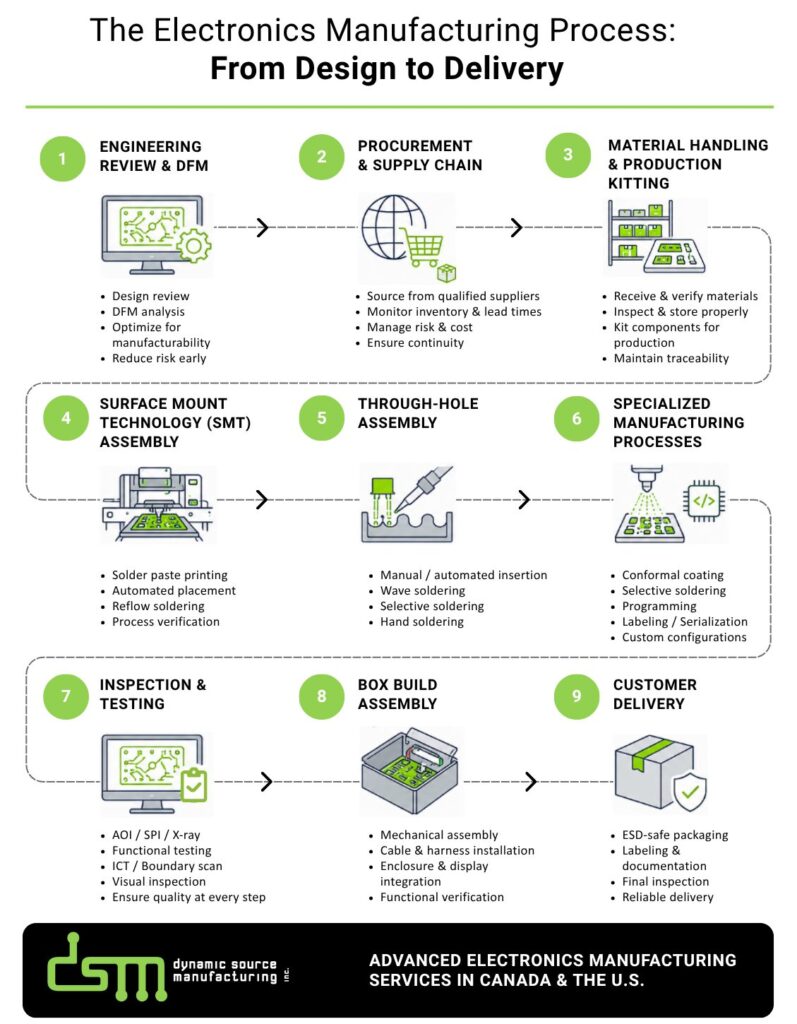
2. Procurement & Supply Chain Management
Once the design is approved, procurement teams begin sourcing electronic components from qualified suppliers and authorized distributors.
This stage involves much more than purchasing parts. Supply chain specialists continuously monitor inventory levels, lead times, component lifecycles, and potential shortages to minimize production delays.
An effective procurement strategy focuses on:
- Component availability
- Supplier quality
- Cost optimization
- Inventory planning
- Risk mitigation
Strong supplier relationships and proactive planning help maintain production continuity even during changing market conditions.
3. Material Handling & Production Kitting
Before production begins, every incoming component is received, verified, and entered into inventory.
Materials are inspected, properly stored, and organized into production kits containing everything required for each manufacturing order. Accurate kitting reduces handling errors and ensures production lines receive the correct materials at the right time.
Throughout this process, manufacturers maintain complete material traceability for every production lot.
4. Surface Mount Technology (SMT) Assembly
Surface Mount Technology (SMT) is the core of modern electronics manufacturing. Automated production equipment places thousands of components per hour with exceptional speed and accuracy.
The SMT process typically includes:
- Solder paste printing
- Automated component placement
- Reflow soldering
- Process verification
Precise machine programming, thermal profiling, and continuous process monitoring ensure consistent solder joints across high-volume production runs.
5. Through-Hole Assembly
Although most components are surface mounted, many electronic products still require through-hole assembly for connectors, transformers, power components, and other mechanically robust devices.
Depending on product requirements, manufacturers use:
- Manual component insertion
- Automated insertion equipment
- Wave soldering
- Selective soldering
- Hand soldering
These processes often complement SMT assembly, particularly in industrial, aerospace, medical, and communications applications.
6. Specialized Manufacturing Processes
Many products require additional manufacturing steps before final assembly.
Depending on customer specifications, these may include:
- Conformal coating
- Selective soldering
- Firmware programming
- Product labeling
- Serialization
- Customer-specific configurations
These specialized processes improve environmental protection, product identification, regulatory compliance, and overall functionality.
7. Inspection & Testing
Quality is verified throughout the manufacturing process rather than only at the end of production.
Modern inspection technologies detect defects early and help maintain high manufacturing yields. Depending on the product, inspection may include:
- Automated Optical Inspection (AOI)
- Solder Paste Inspection (SPI)
- X-ray inspection
- Functional testing
- In-circuit testing (ICT)
- Visual inspection
Combining automated inspection with trained quality personnel ensures every assembly meets customer specifications before moving to the next stage.
8. Box Build Assembly
Many projects extend beyond PCB assembly into complete system integration.
Box build services may include:
- Mechanical assembly
- Cable and wire harness installation
- Enclosure integration
- Display installation
- Final product configuration
- Functional verification
By managing both electronic assembly and mechanical integration, manufacturers simplify the supply chain and reduce overall production complexity.
9. Packaging & Shipping
The final stage prepares products for safe delivery.
Assemblies are packaged according to customer requirements using appropriate ESD protection, labeling, documentation, and shipping methods. Final inspections verify product quality, packaging integrity, and order accuracy before shipment.
Proper packaging protects sensitive electronic assemblies throughout transportation while ensuring products arrive ready for installation or deployment.
From Design to Delivery
Every stage of the electronics manufacturing process plays an important role in product quality, reliability, and long-term performance. A structured manufacturing workflow helps reduce production risks, improve yields, shorten lead times, and ensure consistent results from prototype through full-scale production.
At Dynamic Source Manufacturing (DSM), this end-to-end process forms the foundation of every project we build. From Design for Manufacturability (DFM) reviews and strategic procurement to advanced PCB assembly, box build integration, testing, and supply chain management, our teams work together to deliver high-quality electronic assemblies for customers across a wide range of industries.
Reach out to DSM today: dsmsales@dynamicsourcemfg.com
Book a facility tour: Contact DSM

