
Selective vs. Wave vs. Hand Soldering: Choosing the Right Process for High-Reliability PCB Assemblies
Through-hole components continue to play a critical role in many electronic products, especially in industries where reliability is essential. While surface mount technology dominates modern PCB assembly, connectors, transformers, relays, and high-power components still rely on through-hole soldering to provide the mechanical strength and electrical performance these applications require.
However, through-hole soldering is not a one-size-fits-all process. Manufacturing engineers evaluate every PCB assembly before selecting the most appropriate soldering method. The right choice improves quality, controls manufacturing costs, and supports long-term product reliability.
What Is Through-Hole Soldering in Electronics Manufacturing?
Through-hole soldering creates a permanent electrical and mechanical connection by soldering component leads that pass through drilled holes in a printed circuit board (PCB).
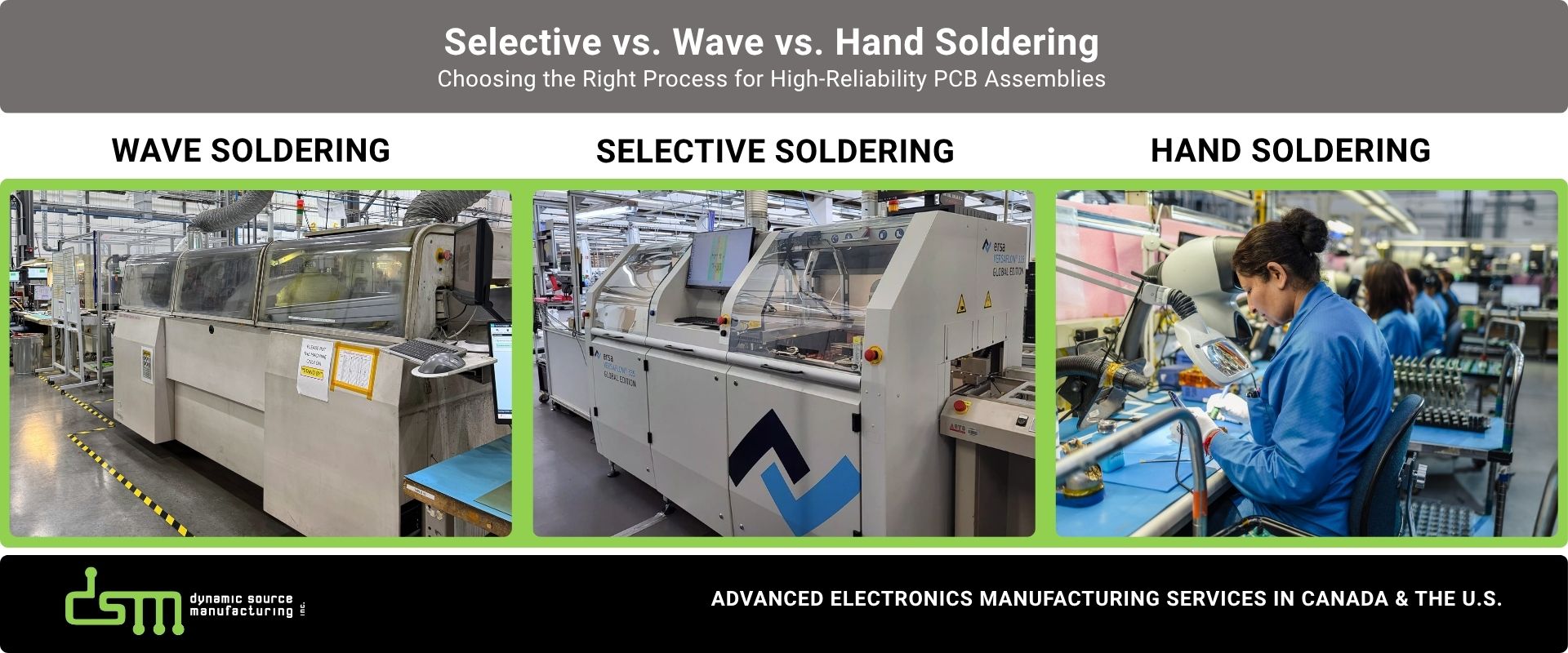
In electronics manufacturing services (EMS), three primary methods are used:
- Wave soldering for high-volume production.
- Selective soldering for complex or mixed-technology assemblies.
- Hand soldering for prototypes, specialized components, and low-volume production.
Each process serves a different purpose, which is why selecting the right method is an important part of Design for Manufacturability (DFM).
Through-Hole Does Not Always Mean Wave Soldering
Wave soldering has been an industry standard for decades because it efficiently solders many through-hole components in a single pass. During the process, the bottom side of the PCB moves across a continuous wave of molten solder, making it ideal for high-volume assemblies with conventional through-hole layouts.
Today’s PCB assemblies, however, are far more complex. Many include fine-pitch SMT devices, bottom-side components, or heat-sensitive materials that require greater process control. As a result, wave soldering is no longer the default choice for every design.
When Selective Soldering Delivers Better Results
Selective soldering applies solder only where it is needed using programmable nozzles. This targeted approach reduces thermal exposure while maintaining excellent repeatability.
It is often the preferred solution when a PCB includes:
- Mixed SMT and through-hole technologies
- Sensitive or closely spaced components
- Complex board layouts
- High-reliability requirements
Although selective soldering typically has longer cycle times than wave soldering, the additional precision often reduces defects and rework, making it the better long-term solution for many complex assemblies.
Why Hand Soldering Still Has a Place
Automation continues to advance, yet hand soldering remains an important manufacturing process.
Experienced operators following IPC workmanship standards can consistently produce high-quality solder joints for:
- Prototype builds
- Engineering validation units
- Low-volume production
- Oversized or inaccessible components
- Final touch-up or rework
Rather than replacing automation, hand soldering complements automated processes where flexibility is more valuable than production speed.
Mixed-Technology Assemblies Often Require Multiple Processes
Modern PCB assemblies rarely rely on a single soldering method. Instead, manufacturing engineers combine processes to achieve the best balance between efficiency and quality.
A typical production flow may include:
- SMT assembly using reflow soldering.
- Selective soldering for critical through-hole components.
- Hand soldering for specialty components or final assembly.
By matching each process to the specific requirements of the product, manufacturers improve both production efficiency and product reliability.
Balancing Cost, Quality, and Manufacturability
Selecting a soldering process involves much more than comparing equipment costs. Manufacturing engineers also evaluate production volume, board complexity, component placement, inspection requirements, and long-term reliability.
In general:
- Wave soldering offers the lowest cost per board for large production volumes.
- Selective soldering provides greater flexibility and process control for complex assemblies.
- Hand soldering offers maximum adaptability for prototypes and specialized applications.
The most economical solution is not always the least expensive process. Instead, it is the one that consistently delivers the required quality while minimizing defects, rework, and manufacturing risk.
Design Considerations Matter
Even the most advanced soldering equipment cannot compensate for poor PCB design.
During a DFM review, manufacturing engineers evaluate factors such as:
- Component spacing
- Hole and pad geometry
- Thermal mass differences
- Connector placement
- Board orientation
- Solder accessibility
Addressing these considerations early helps improve yields, reduce production costs, and avoid manufacturing challenges before production begins.

How an EMS Partner Optimizes the Process
At DSM, selecting the right soldering process starts long before a PCB reaches the production floor. During the engineering and DFM review, our team evaluates the PCB layout, component mix, production volumes, reliability requirements, and potential manufacturing risks to determine the most efficient soldering strategy.
Rather than applying a standard process to every assembly, we recommend the combination of wave soldering, selective soldering, and hand soldering that best fits each product. This approach helps reduce defects, improve yields, shorten production cycles, and support long-term product reliability.
By involving engineering, quality, and manufacturing teams early in the NPI process, Dynamic Source Manufacturing helps OEMs identify potential challenges before production begins, resulting in a smoother transition from design to volume manufacturing.
Reach out to DSM today: dsmsales@dynamicsourcemfg.com
Book a facility tour: Contact DSM