
The Digital Thread Behind Every Board: Rethinking Material Traceability
In today’s electronics manufacturing environment, material traceability has become a defining element of how high-quality, reliable products are built. As supply chains grow more complex and customer expectations continue to rise, manufacturers need far more than basic lot tracking. They need a clear, connected view of how every product was made and what materials went into it.
At DSM, traceability is woven into our production processes, our systems, and our daily decision-making. Our approach aligns with Level 4 traceability, providing end-to-end visibility from incoming materials through final assembly and testing. This level of insight allows us to manufacture with greater confidence, precision, and accountability.

What material traceability means in practice
Material traceability refers to the ability to track materials and components throughout the entire manufacturing lifecycle, from the moment they arrive at a facility to the moment the finished product is shipped to the customer.
In practice, this means having clear visibility into:
- Where materials originated
- Supplier and batch information
- How materials were handled and stored
- Each production step they passed through
- How they performed during inspection and testing
Strong traceability enables manufacturers to investigate issues more efficiently, strengthen quality control, and demonstrate compliance with industry standards. Equally important, it gives customers greater confidence that their products are being built in a controlled, transparent, and repeatable way.
Understanding levels of traceability
Traceability is often described in different levels of maturity.
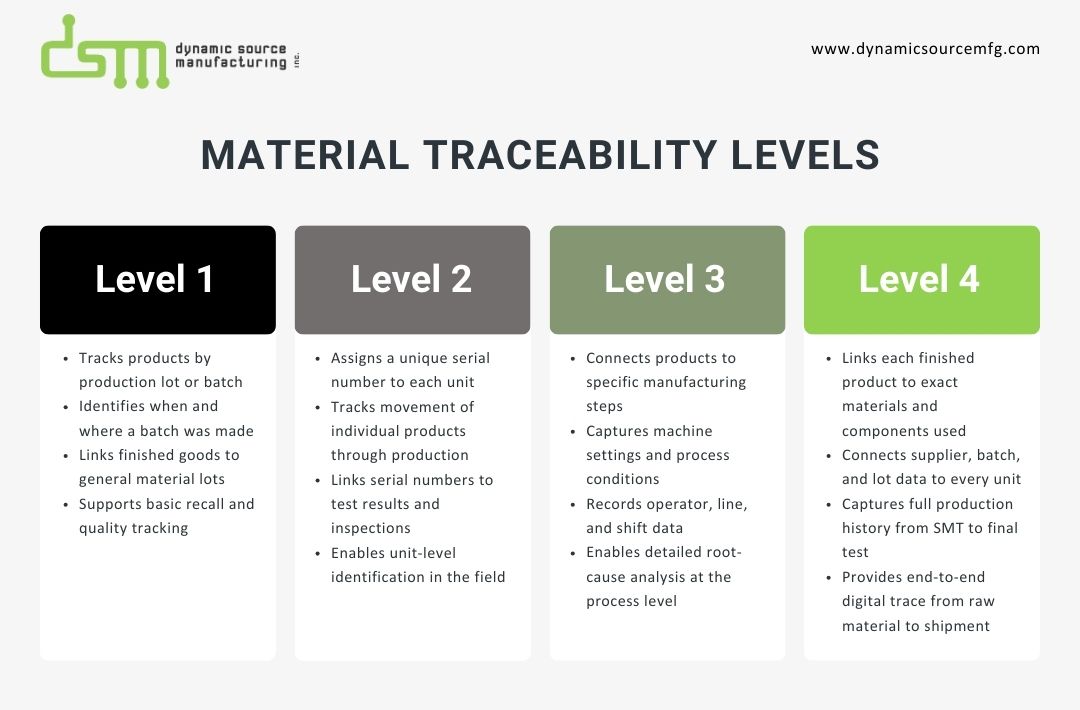
Many manufacturers operate at Level 2 or Level 3. Level 4 traceability goes further by tying every unit back to its material origins, supplier data, and process records. For industries such as automotive, medical, and defense, this depth of detail is increasingly becoming an expectation rather than an exception.
Why Level 4 traceability matters for electronics
Electronics manufacturing involves thousands of small components, tight tolerances, and multiple interconnected production steps. Even minor variations in materials or processes can affect performance, reliability, or long-term durability.
With Level 4 traceability, manufacturers can:
- Identify exactly which materials were used in a specific product
- Trace potential issues back to a particular supplier or batch
- Analyze patterns over time to prevent recurring problems
- Support faster and more accurate root cause investigations
Instead of relying on fragmented records or manual tracking, engineers can work with structured, connected data that makes troubleshooting more precise and efficient. This is especially critical when manufacturing complex, high-reliability electronics.
How DSM implements Level 4 traceability
At DSM, material traceability is designed into our operations from the start. Every incoming component is logged, labeled, and linked to its supplier and batch information. As materials move through production, each step is recorded and associated with the relevant product or serial number.

Our manufacturing systems capture key process data such as:
- Assembly steps
- Machine settings
- Operator involvement
- Inspection and test results
This creates a clear digital thread that connects raw materials to finished products, providing a complete and searchable production history for every unit we build.
A key part of our approach is the use of Juki towers in our SMT process. These intelligent material towers help ensure that the correct components are used at the right place and time. They reduce the risk of human error, track material usage in real time, and feed accurate data back into our production systems.
The combination of smart equipment, disciplined processes, and integrated data capture is what enables true Level 4 traceability at DSM.
What this means for our customers
For our customers, advanced material traceability delivers practical benefits that extend well beyond compliance.
When issues arise, we can investigate them quickly and precisely. Instead of broad or speculative analysis, we can determine whether a problem is linked to a specific material batch, supplier, or production condition. This reduces downtime, minimizes risk, and supports faster resolution.
Traceability also strengthens alignment with quality standards such as ISO 9001. It makes audits smoother, documentation more reliable, and quality reporting more transparent.
Over time, traceability data supports better decision-making around suppliers, materials, and manufacturing processes. It encourages continuous improvement rather than reactive problem-solving, helping both DSM and our customers build stronger, more resilient supply chains.
Traceability in a more digital factory
As manufacturing becomes more connected and data-driven, traceability is emerging as a foundational capability rather than an add-on. Industry 4.0 initiatives, digital twins, and advanced quality systems all depend on accurate, structured manufacturing data.
Companies that invest in strong traceability today are better positioned to meet future regulatory requirements, evolving customer expectations, and new technological developments.
Looking ahead
Material traceability plays a central role in modern electronics manufacturing. Level 4 traceability, supported by integrated systems and smart tools like Juki towers, provides the visibility and control needed to build reliable, high-quality products.
At DSM, traceability supports not only quality and compliance, but also trust, accountability, and continuous improvement in how we manufacture for our customers.
Reach out today: dsmsales@dynamicsourcemfg.com
Book a facility tour: Contact DSM