

BEAD Program and the New Rules of Broadband Manufacturing
The U.S. government is making one of the largest infrastructure investments in its history through the Broadband Equity, Access, and Deployment (BEAD) Program. With $42.45 billion in federal funding, the program is designed to expand high-speed internet access across underserved and unserved regions in the United States.
But beyond broadband access, BEAD is reshaping how infrastructure is built, how supply chains are structured, and how OEMs must operate to qualify for funding.

A Program Built Around National Infrastructure and Control
BEAD is not just a connectivity initiative. It is a long-term infrastructure program tied directly to economic growth, national resilience, and digital equity. The funding supports:
- Broadband network deployment and upgrades
- Infrastructure planning and mapping
- Adoption and affordability initiatives
The goal is clear: Achieve nationwide, reliable broadband coverage. To get there, the program prioritizes projects that can deliver long-term, scalable, and sustainable infrastructure.
Who Qualifies and How the Ecosystem Works
Funding is distributed at the state level, but execution happens through a broader ecosystem. Eligible participants include:
- Internet Service Providers (ISPs)
- Infrastructure developers and network operators
- Public-private partnerships
- Local governments, cooperatives, and nonprofits
These entities are selected through competitive processes to design, build, and deploy broadband networks.
For OEMs, this creates a significant opportunity.
The companies that supply the electronics, systems, and infrastructure components behind these networks become critical to project delivery.
Key Requirements OEMs Must Meet
To participate in BEAD-funded projects, organizations must align with strict technical and operational requirements.
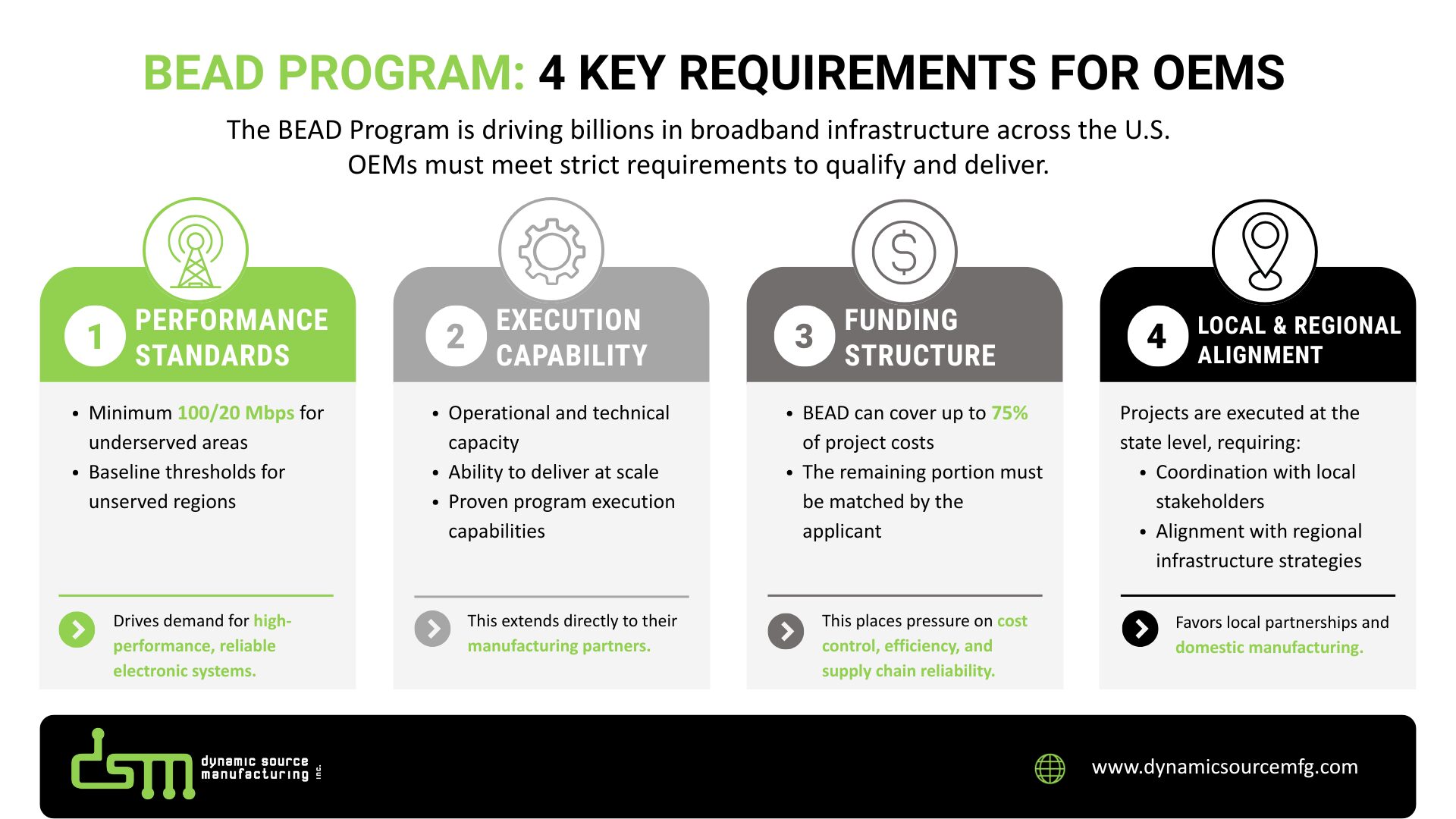
1. Performance Standards
Projects must meet defined broadband speeds, including:
- Minimum 100/20 Mbps for underserved areas
- Baseline thresholds for unserved regions
This drives demand for high-performance, reliable electronic systems.
2. Execution Capability
Applicants must demonstrate:
- Operational and technical capacity
- Ability to deliver at scale
- Proven program execution capabilities
This extends directly to their manufacturing partners.
3. Funding Structure
- BEAD can cover up to 75% of project costs
- The remaining portion must be matched by the applicant
This places pressure on cost control, efficiency, and supply chain reliability.
4. Local and Regional Alignment
Projects are designed and executed at the state level, requiring:
- Coordination with local stakeholders
- Alignment with regional infrastructure strategies
This reinforces the importance of local manufacturing and supply chain presence.
Why Local Manufacturing Is Critical for BEAD Programs
The BEAD program is a U.S.-focused infrastructure initiative, and that has direct implications for how broadband systems are designed, built, and deployed. For OEMs, success is no longer defined solely by product performance, but by the ability to operate within a controlled, transparent, and compliant supply chain.
As projects scale across regions, visibility across sourcing, production, and delivery becomes critical, while compliance requirements continue to tighten and reliance on offshore supply chains introduces increasing risk. In this environment, local manufacturing provides a level of control that global, distributed models cannot match.
Building within the United States enables faster execution, more predictable scaling, and stronger alignment between engineering and production, while improving quality control and traceability across complex programs. For large, multi-phase deployments like BEAD, these factors directly influence timelines and outcomes.
Manufacturing location is no longer just an operational decision. It is a strategic requirement for qualifying, delivering, and competing in BEAD-funded programs.
This is especially relevant given the systems involved. Broadband infrastructure depends on complex electronics, from network control systems and embedded platforms to edge devices and power management systems, all of which must perform reliably at scale.
In this context, manufacturing capability goes beyond production. It underpins the reliability, control, and scalability that modern infrastructure programs demand.
How DSM Supports BEAD-Driven OEMs
Dynamic Source Manufacturing supports OEMs participating in large-scale infrastructure programs by providing high-reliability electronics manufacturing within North America.
With a facility in Tempe, Arizona, DSM enables U.S.-based production aligned with BEAD program requirements and expectations.
We support a wide range of systems and subsystems, including:
- Communications and network electronics
- Embedded and control systems
- Infrastructure hardware for broadband deployment
- Advanced electronics for high-reliability applications
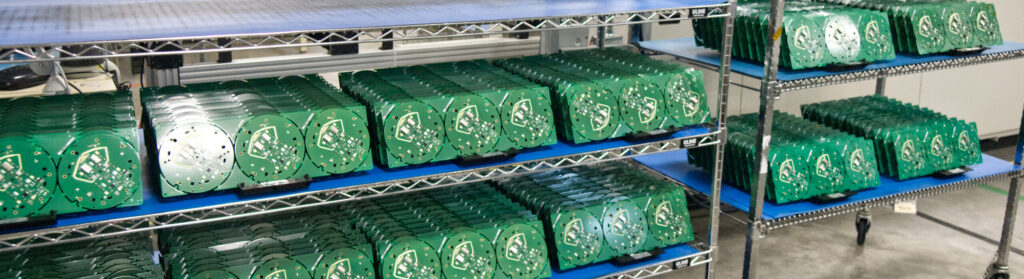
Our capabilities are built around:
- Precision SMT and PCB assembly
- Advanced inspection and testing (SPI, AOI, X-ray)
- MES-driven traceability
- High-mix, scalable production

Our advanced manufacturing capabilities, combined with local U.S. production and a well-established domestic supply chain, enable OEMs to meet stringent performance and quality requirements while maintaining full visibility across production. This approach supports scalable deployment without supply chain disruption and ensures alignment with domestic infrastructure expectations.
Positioning for the Next Phase of Infrastructure Growth
The BEAD program marks a meaningful shift in how infrastructure projects are funded and delivered in the U.S., placing greater emphasis on execution capability, supply chain control, and alignment with local and regional priorities.
For OEMs, success will depend not only on product design, but on the ability to deliver within a compliant, reliable, and scalable manufacturing ecosystem. This is where the right manufacturing partner becomes critical.
Dynamic Source Manufacturing is built to support that transition, enabling OEMs to meet program requirements while delivering the performance, consistency, and control that large-scale infrastructure demands.
Reach out today: dsmsales@dynamicsourcemfg.com
Book a facility tour: Contact DSM