

Tariffs, Trade Uncertainty, and the New Manufacturing Map in North America
For OEMs across North America, trade policy has become a core operational and supply chain challenge that directly affects sourcing decisions, manufacturing footprints, pricing strategies, and long-term production planning.
Over the last 18 months, manufacturers have faced a growing combination of U.S. tariffs, geopolitical instability, rising component costs, and uncertainty surrounding the 2026 review of the United States-Mexico-Canada Agreement (USMCA). At the same time, procurement and operations teams are reassessing how dependent they want to remain on long overseas supply chains, particularly for electronics, industrial systems, and mission-critical programs.
The result is a major shift in how OEMs approach manufacturing strategy in North America.
The 2026 USMCA Review Is Already Influencing Manufacturing Decisions
Although the formal USMCA review begins in July 2026, many manufacturers are already preparing for possible changes to regional sourcing rules, tariffs, and country-of-origin requirements.
One of the biggest concerns is the possibility of tighter Rules of Origin requirements for industrial and automotive products. Automotive manufacturers, for example, already face requirements that 75% of vehicle content originate within North America to qualify for duty-free access under USMCA.
At the same time, scrutiny around Chinese content in North American supply chains continues to increase. Policymakers and industry groups are actively discussing stronger restrictions on Chinese components and manufacturing influence within USMCA-qualified products.
This creates uncertainty for OEMs that still rely heavily on offshore sourcing models.
Rising Tariffs and Component Costs Are Pressuring OEMs
Trade policy changes are also driving direct cost increases across several sectors.
Recent U.S. tariff measures on imported steel, aluminum, and industrial goods have increased manufacturing costs for many North American producers. In the heavy truck sector alone, manufacturers are now facing substantial tariff exposure on non-USMCA-compliant parts and imported materials.
As a result, companies are reassessing where products are built and how supply chains are structured.
This is particularly important in industries such as:
- Aerospace and defence
- Communications infrastructure
- Industrial equipment
- Automotive and EV systems
- Advanced electronics
- Satellite communications and avionics
Canada, the U.S., and Mexico Are Playing Different Roles
North American manufacturing is becoming increasingly interconnected, but each region serves a different strategic purpose.
Mexico continues to attract high-volume manufacturing investment due to labor availability and lower production costs. In fact, foreign direct investment into Mexico reached record levels in 2025 as manufacturers expanded regional operations ahead of the USMCA review.
The United States remains critical for domestic content requirements, defence-related production, and programs tied to federal funding or national security regulations.
Meanwhile, Canada is increasingly positioned as a stable, technically sophisticated manufacturing environment for aerospace, defence, communications, energy, and advanced industrial programs. Canadian manufacturing also offers strong advantages around workforce quality, geopolitical stability, Controlled Goods compliance, and integration into broader North American supply chains.
As OEMs reassess supplier diversification strategies, many are moving toward a blended regional model rather than relying on a single geography.
Reducing Dependence on Long Overseas Supply Chains
One of the clearest shifts happening today is the move away from overly centralized overseas sourcing models.
Over the last several years, manufacturers have experienced:
- shipping disruptions
- geopolitical instability
- extended lead times
- component shortages
- unpredictable freight costs
- compliance complexity
- reduced supply chain visibility
As a result, more OEMs are prioritizing regional manufacturing ecosystems that offer faster communication, shorter logistics timelines, improved traceability, and greater production flexibility.

At Dynamic Source Manufacturing (DSM), we are seeing this trend accelerate across aerospace, communications, industrial, and advanced technology programs.
Our dual-facility manufacturing model in Calgary, Alberta and Tempe, Arizona allows customers to build more resilient North American supply chains while maintaining flexibility around regional sourcing, production strategy, and customer requirements.
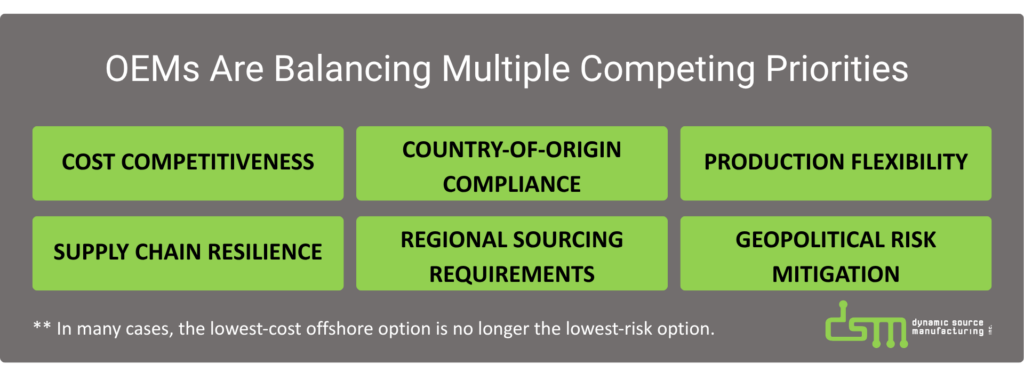
For many OEMs, the conversation is no longer simply about reducing cost. It is about reducing risk while maintaining the ability to scale efficiently within an increasingly complex trade environment.
As trade policy, tariffs, and sourcing regulations continue to evolve, regional manufacturing partnerships are becoming a much more strategic part of long-term operational planning.
Reach out today: dsmsales@dynamicsourcemfg.com
Book a facility tour: Contact DSM