
Supply Chain Management in 2026: What OEMs Need to Know
As global supply chain conditions continue to evolve, new pressures are emerging across memory, semiconductors, and critical electronic components. Original equipment manufacturers (OEMs) that plan early, build strong partnerships, and stay proactive will be best positioned to navigate ongoing volatility and protect long-term product continuity.
Below are the key trends and practical actions OEMs should consider as they prepare for 2026.

Memory Constraints
We are seeing unprecedented demand for memory, driven largely by the rapid expansion of AI applications and high-performance computing. This demand is creating significant pressure across the global supply chain, including:
- Large technology companies securing priority access to fabrication capacity, further limiting availability for the broader market
- Extended lead times, with some components becoming difficult or impossible to source
- Accelerated end-of-life (EOL) activity for certain legacy memory devices
- Rapid depletion of available inventory, often selling out within hours of release
- Suppliers designating more products as NCNR (Non-Cancelable, Non-Returnable), increasing procurement risk
These trends are increasing the importance of visibility, forecasting, and early engagement with manufacturing and supply chain partners.
Pricing Impact
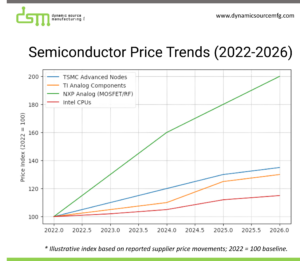
Supply constraints and sustained demand are contributing to cost increases across multiple areas of the electronics ecosystem:
- Memory component price increases of up to 200% on certain parts
- Analog Devices (ADI) and Texas Instruments (TI) implementing increases ranging from 15–30% across various product lines
- Connector suppliers such as Molex and TE Connectivity also announcing price adjustments
- Gold reaching an all-time high, driving up printed circuit board (PCB) costs
- Continued inflation impacting materials, labor, energy, and logistics
As a result, OEMs are facing greater cost volatility and a growing need for strategic sourcing and supply chain planning.
Preventative Measures to Strengthen Supply Chain Resilience
In today’s environment, proactive planning and strong collaboration are essential. Leading EMS partners like DSM take a structured, forward-looking approach to risk management, working closely with customers and the broader supplier ecosystem to anticipate challenges before they impact production.
This includes maintaining deep visibility into market trends, strengthening supplier relationships, and building flexible sourcing strategies that support continuity and cost stability. By combining technical expertise, cross-functional alignment, and early engagement, strong manufacturing partners help reduce uncertainty and create more resilient, predictable programs.
Ultimately, the goal is not just to react to disruption, but to build supply chains that are adaptable, scalable, and aligned with long-term customer objectives.
How OEMs Can Strengthen Their Position
To navigate ongoing volatility and protect product continuity, OEMs should focus on early planning, transparency, and partnership. Organizations that share long-term demand outlooks, engage manufacturing partners earlier in the product lifecycle, and align supply chain strategy with business goals are better positioned to secure supply, manage risk, and scale with confidence.
A collaborative, forward-thinking approach enables faster decision-making, improved manufacturability, and stronger resilience in an increasingly complex global environment.
Stronger Supply Chains Together
The strongest supply chains are built through collaboration, transparency, and early engagement. At DSM, we partner with OEMs to anticipate challenges, protect continuity, and support long-term growth through proactive planning and cross-functional collaboration.
If your team is preparing for 2026 or reviewing your supply chain strategy, we’d be happy to discuss how we can support your goals.
Reach out today: dsmsales@dynamicsourcemfg.com
Book a facility tour: Contact DSM