

The Rise of Direct-to-Device Satellite Connectivity, And What It Means for OEMs
For decades, mobile connectivity has relied almost entirely on terrestrial networks, leaving remote regions, industrial operations, transportation routes, and critical infrastructure with limited coverage. That is changing quickly.
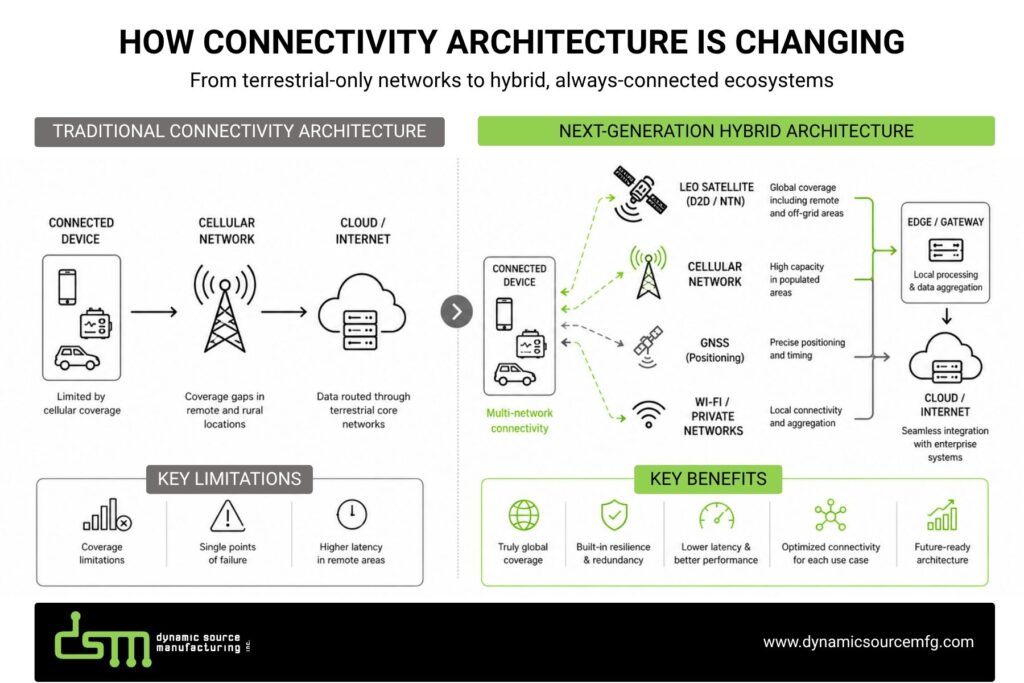
Direct-to-device (D2D) satellite connectivity is moving from emerging technology to commercial reality. Smartphones, vehicles, industrial equipment, and connected devices are increasingly being designed to communicate directly with low Earth orbit (LEO) satellites using standard or minimally modified hardware.
Telecom providers, satellite operators, semiconductor companies, and OEMs are now investing heavily in non-terrestrial networks (NTN) as the next evolution of global connectivity infrastructure. What was once viewed as an emergency backup feature is rapidly becoming part of long-term product and network strategy.

What Is Direct-to-Device Satellite Connectivity?
Direct-to-device connectivity allows consumer and industrial devices to communicate directly with satellites without requiring traditional satellite phones or bulky external terminals.
Unlike legacy satellite communications systems that relied on specialized hardware, newer D2D architectures are being developed around existing mobile standards and terrestrial spectrum frameworks. Companies such as SpaceX Starlink, AST SpaceMobile, Lynk Global, and others are working with telecom operators to enable standard smartphones and IoT devices to connect directly to satellite networks.
The industry momentum behind this transition has accelerated significantly in 2026. AT&T, Verizon, and T-Mobile recently announced a joint initiative focused on eliminating cellular dead zones through satellite-based direct-to-device technologies, reflecting how quickly D2D has become a strategic priority for the broader wireless ecosystem.
At the same time, the broader market opportunity is expanding rapidly. Analysts project the direct satellite-to-phone market to grow from approximately $3.5 billion in 2026 to more than $26 billion by 2034.
Why OEMs Are Paying Attention
For OEMs, the implications extend far beyond consumer messaging.
The growing expectation of uninterrupted connectivity is reshaping requirements across transportation, industrial IoT, aerospace, logistics, mining, energy, defense, agriculture, and critical infrastructure systems. Products that previously operated within limited network environments are now expected to maintain visibility, communication, telemetry, or emergency access almost anywhere.
This is especially important for applications where network failure creates operational, safety, or financial risk. Fleet operators want continuous asset visibility across remote routes. Industrial equipment manufacturers are supporting operations in isolated environments. Aerospace and defense systems increasingly require resilient communications architectures that remain functional even when terrestrial infrastructure becomes unavailable.
The market is also being shaped by broader geopolitical and infrastructure trends. Governments and telecom operators are investing heavily in network resiliency, emergency preparedness, and sovereign communications capabilities. Satellite-terrestrial convergence is no longer viewed as a niche technology category. It is becoming part of mainstream communications infrastructure planning.
As a result, OEMs are now being forced to rethink how connected products are designed from the ground up.
Hardware Complexity Is Increasing
One of the most significant changes is happening at the hardware level.
Supporting direct-to-device connectivity introduces new engineering and integration challenges that many traditional connected products were never designed to handle. Devices increasingly need to support coexistence between terrestrial cellular, GNSS, Wi-Fi, Bluetooth, and satellite communications systems within highly constrained form factors.
This affects nearly every aspect of electronics design, including:
- RF architecture
- antenna integration
- PCB layout complexity
- thermal management
- power optimization
- signal integrity
- shielding requirements
- and embedded processing capability
For communications and GNSS hardware specifically, the requirements are becoming substantially more demanding.
Multi-band antenna systems must operate across increasingly crowded frequency environments. RF-sensitive designs require tighter manufacturing tolerances and more sophisticated validation processes. Edge devices are being expected to process more data locally while managing power consumption efficiently enough to support extended remote operation.
As always-connected expectations rise, the distinction between communications hardware, positioning systems, and edge computing platforms is also beginning to disappear.
How Electronics Manufacturing Is Evolving Alongside It
The manufacturing implications are equally significant. As D2D-enabled products become more sophisticated, OEMs are placing greater emphasis on manufacturing partners capable of supporting advanced RF integration, high-reliability assembly processes, and increasingly complex test requirements.
Traditional PCB assembly capabilities alone are no longer enough for many next-generation communications products.
OEMs are now looking for manufacturing environments that can support:
- advanced traceability
- RF-sensitive assembly processes
- functional integration testing
- tighter process control
- lifecycle component management
- and greater engineering collaboration throughout product development
Testing expectations are evolving particularly quickly. Products incorporating hybrid terrestrial-satellite connectivity often require more advanced validation procedures, including RF verification, connectivity testing, environmental reliability testing, and system-level functional validation. Supply chain strategy is becoming more critical as well.
Many D2D architectures rely on specialized RF semiconductors, advanced antenna systems, GNSS modules, and high-performance embedded components that remain exposed to geopolitical pressures and allocation risks. OEMs increasingly need supply chain visibility, sourcing flexibility, and long-term lifecycle support as communications ecosystems continue to evolve.
This is one reason why many companies are reassessing regional manufacturing strategy and trusted North American manufacturing partnerships, particularly for communications, aerospace, industrial, and defense-related electronics.
Building the Next Generation of Connected Infrastructure
As direct-to-device connectivity becomes a core consideration in modern product development, OEMs are being forced to rethink hardware architecture, manufacturing strategy, sourcing decisions, testing requirements, and long-term lifecycle planning.
Supporting the next generation of connected systems requires more than production capacity alone. It demands manufacturing partners with the technical sophistication, RF integration capabilities, traceability systems, and supply chain agility needed to support increasingly complex communications hardware.
At DSM, we work with OEMs across communications, aerospace, industrial technology, and advanced electronics to help bring high-reliability connected products to market through advanced PCB assembly, engineering collaboration, rigorous quality processes, and flexible North American manufacturing.
As uninterrupted global connectivity becomes the new expectation, the companies that adapt early to these evolving requirements will be better positioned to support the future of connected infrastructure.
Reach out today: dsmsales@dynamicsourcemfg.com
Book a facility tour: Contact DSM