

IPC Standards in Electronics Manufacturing: A Technical Guide for OEMs
IPC standards establish widely recognized requirements and acceptance criteria for electronics manufacturing, helping OEMs and manufacturers align on how electronic assemblies should be built and evaluated. For PCB assembly, IPC-A-610 is one of the industry’s most widely used standards for determining whether completed electronic assemblies meet defined workmanship requirements.
For OEMs, specifying the appropriate IPC requirements provides a common technical framework between engineering, quality, procurement, and the electronics manufacturing services (EMS) provider.

What Are IPC Standards in Electronics Manufacturing?
IPC develops standards covering many stages of electronics manufacturing, from printed boards and soldering to completed electronic assemblies. Rather than relying on subjective interpretations of acceptable workmanship, manufacturers can use documented criteria to evaluate characteristics such as component installation, solder connections, cleanliness, conductor conditions, and other assembly attributes.
IPC-A-610, Acceptability of Electronic Assemblies, focuses on the acceptance of completed assemblies. It establishes visual acceptance criteria and defines conditions used by inspectors, operators, and engineers to evaluate workmanship. Importantly, IPC-A-610 defines acceptance criteria rather than the manufacturing processes used to produce the assembly.
Another important standard, J-STD-001, Requirements for Soldered Electrical and Electronic Assemblies, addresses materials, methods, process requirements, and acceptance requirements for soldered assemblies. In practice, J-STD-001 and IPC-A-610 are often used together to establish manufacturing and workmanship expectations.
IPC Class 2 vs. Class 3 Electronics
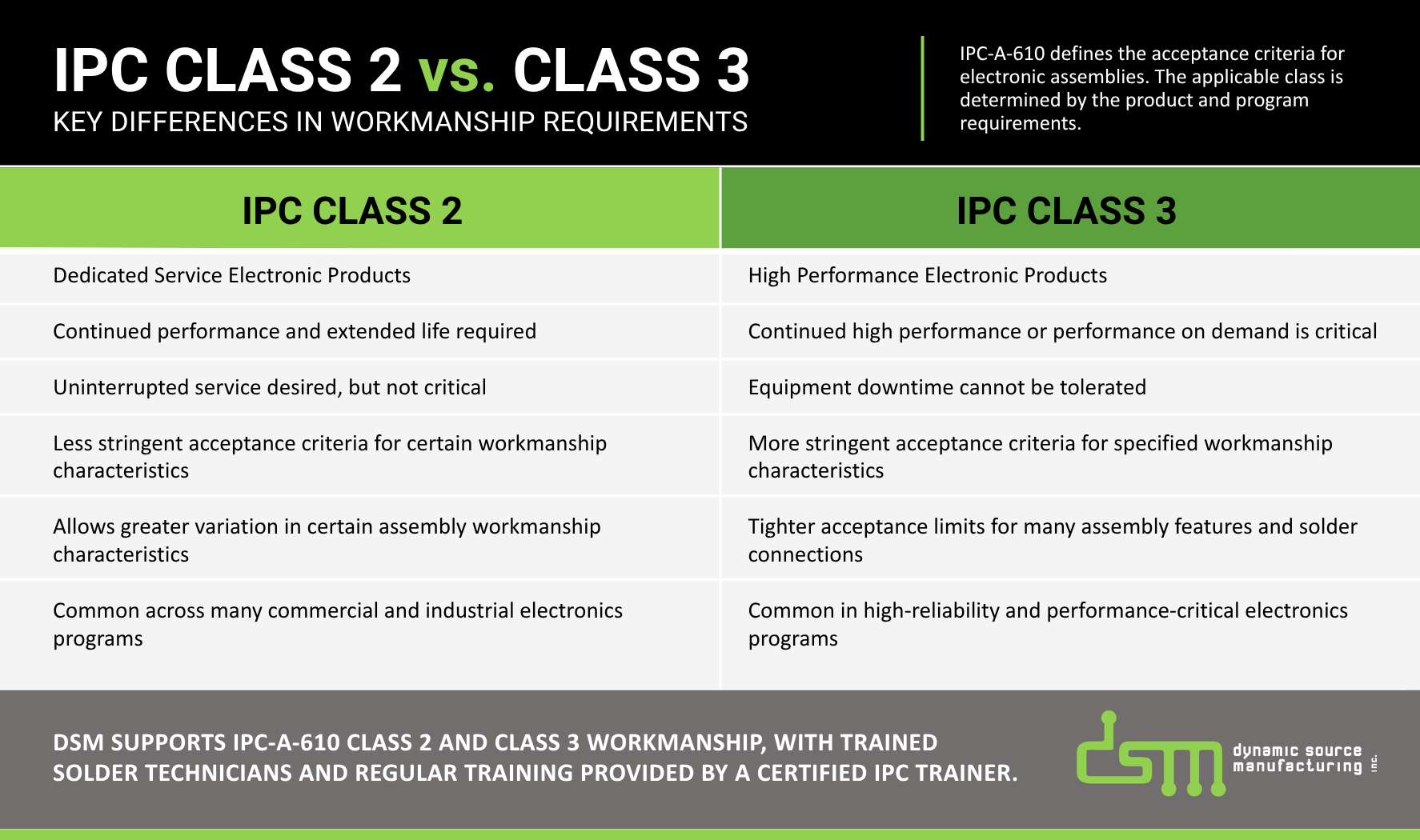
IPC standards recognize different product classes based on the intended application and performance requirements. The customer ultimately has responsibility for identifying the class against which an assembly will be evaluated.
- CLASS 2: Dedicated Service Electronic Products applies to products where continued performance and extended service life are required, but uninterrupted operation is not considered critical.
- CLASS 3: High Performance Electronic Products applies where continued high performance or performance on demand is critical, equipment downtime cannot be tolerated, or the product may operate in unusually harsh environments. IPC cites life-support and other critical systems as examples.
Class 3 should not simply be interpreted as “better quality.” It establishes more stringent acceptance requirements because the consequences of an assembly failure and the operating conditions may be different. The appropriate class therefore needs to reflect the product’s intended use and contractual requirements.
How IPC-A-610 Requirements Apply to PCB Assembly
IPC workmanship standards become particularly important when translating an OEM’s design documentation into repeatable production requirements. IPC-A-610 provides criteria covering areas such as component mounting, soldering, terminals, printed circuit boards, and assemblies.
However, IPC compliance does not replace product-specific engineering documentation. Drawings, bills of materials, customer specifications, approved deviations, and contractual requirements remain part of the manufacturing definition. The applicable IPC class and standard revision should therefore be established clearly before production begins.
Manufacturing controls also extend beyond visual inspection. Processes such as solder paste inspection (SPI), automated optical inspection (AOI), X-ray inspection, and functional testing can provide additional process and product verification depending on the assembly. Dynamic Source Manufacturing (DSM), for example, uses advanced inspection technologies as part of its broader electronics manufacturing process.
IPC Class 2 and Class 3 Workmanship at DSM

Dynamic Source Manufacturing supports programs requiring both IPC Class 2 and IPC Class 3 workmanship. Product workmanship conforms to IPC-A-610 Class 2 or Class 3 according to the requirements established for each customer program.
DSM maintains IPC Class 2 and Class 3 solder technicians and provides regular training with a certified IPC trainer. This ongoing training helps manufacturing personnel apply workmanship criteria consistently as customer requirements, products, and manufacturing processes change.
IPC requirements also operate within DSM’s broader quality system. DSM is ISO 9001:2015 certified, and its manufacturing operations incorporate inspection, process controls, traceability, and documented quality procedures.
For OEMs evaluating an electronics manufacturing partner, the important question is therefore not simply whether a manufacturer “works to IPC.” The applicable standard, product class, revision, workmanship requirements, inspection criteria, and any customer-specific requirements should all be defined as part of the program.
Learn more about DSM’s electronics manufacturing and quality capabilities, review our certifications and compliance standards, or contact our team to discuss your program requirements.
Reach out to DSM today: dsmsales@dynamicsourcemfg.com
Book a facility tour: Contact DSM

