

Connected Canada: The Growth of Communications & GNSS Technology and the Role of Domestic Electronics Manufacturing
Canada’s communications landscape is entering a period of significant investment. The country’s geography, growing dependence on connected infrastructure and renewed focus on Arctic sovereignty are driving development across satellite communications, advanced wireless networks and positioning, navigation and timing technologies.
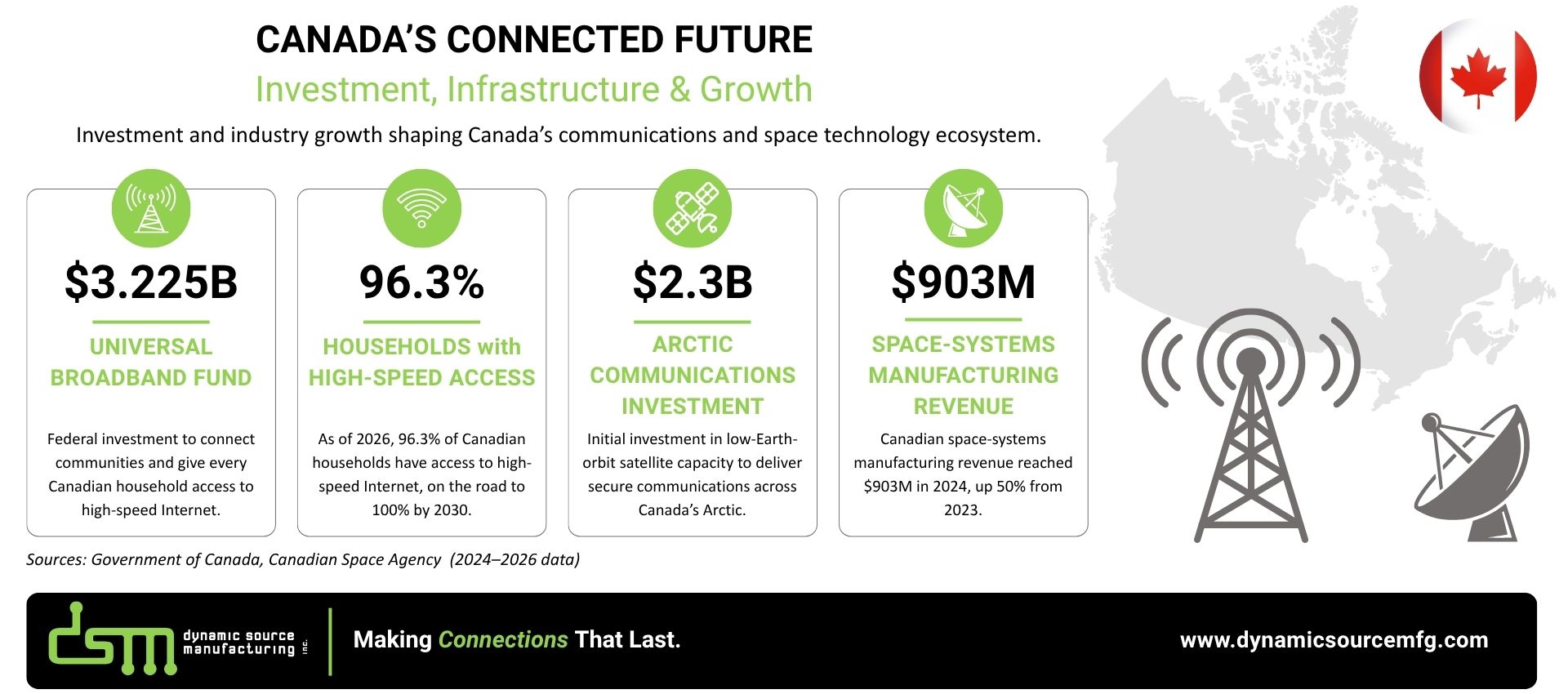
The numbers show where that momentum is building. Canada’s space sector generated approximately $5 billion in revenue in 2024 and contributed $3.8 billion to GDP. Navigation accounted for $700 million, while satellite communications remained the sector’s largest segment. More significantly for hardware manufacturers, space systems manufacturing revenue increased 50% in 2024 to $903 million.

Connectivity is becoming strategic infrastructure
Canada has practical reasons to invest in communications technology. Vast distances and low population density make conventional terrestrial infrastructure difficult to extend into every community. At the same time, communications networks increasingly support critical infrastructure, defence, transportation, resource development and emergency response.
The federal Universal Broadband Fund represents $3.225 billion in investment, with a target of providing high-speed Internet access to 100% of Canadian households by 2030. As of 2026, 96.3% have access. Canada has also secured $600 million in capacity on the Telesat Lightspeed low-Earth-orbit network to help serve difficult-to-reach northern and remote communities.
Investment is extending beyond broadband. The federal government committed $45 million toward a 5G testbed and living-lab program for advanced network technologies and AI-enabled applications. Canada has also established a regulatory framework that enables supplemental mobile coverage directly through satellites, expanding the potential convergence of terrestrial and space-based communications.
GNSS and resilient positioning are part of the same evolution
Reliable connectivity increasingly intersects with accurate positioning and timing.
GNSS – Global Navigation Satellite Systems, including GPS, supports far more than vehicle navigation. Positioning and timing signals underpin autonomous systems, telecommunications networks, precision agriculture, surveying, transportation, financial systems and critical infrastructure.
Canada’s navigation segment reached $700 million in revenue in 2024, up from $418 million in 2019. Current research is also looking beyond conventional GNSS. In 2026, the Canadian Space Agency funded work on LEO-based positioning, navigation and timing (PNT) designed to complement GNSS and improve resilience against interference and disruption.
That resilience matters as positioning, timing and communications become increasingly embedded in systems that cannot tolerate prolonged loss of service.
Sovereignty is accelerating investment
Communications capability has also become a national-security priority.
In August 2026, Canada awarded an initial $2.3-billion contract to Telesat for the first phase of its Enhanced Satellite Communications Project – Polar. The project will use Telesat’s Lightspeed constellation to provide secure military communications in the Arctic and other high-latitude regions. The agreement enables the constellation to expand by 69 satellites, from 156 to 225, with satellites manufactured in Montréal by MDA Space.
This creates an important industrial question: how much of the technology surrounding Canada’s next generation of connected systems can also be manufactured domestically?
Canada’s opportunity and manufacturing challenge
Strong research, engineering and product development do not automatically translate into scalable production.
Communications and GNSS products can place demanding requirements on electronics manufacturing, including:
- RF-sensitive PCB assemblies and complex component placement
- precise process control and inspection
- antenna and module integration
- programming, calibration and functional testing
- component traceability and long-term supply-chain management
As Canadian companies move from prototypes into commercial production, access to domestic electronics manufacturing can shorten engineering feedback loops, improve supply-chain visibility and keep manufacturing expertise closer to product development.
It also strengthens Canada’s ability to turn investment in communications infrastructure into lasting industrial capacity rather than technology development alone.
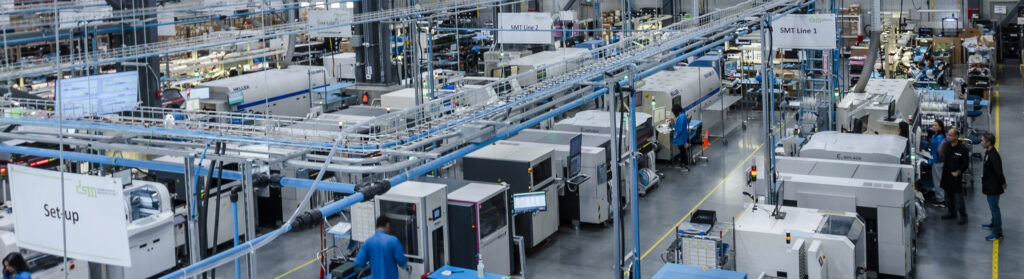
Dynamic Source Manufacturing, Calgary, AB: Domestic electronics manufacturing capacity helps Canadian technology companies move from product development to scalable, reliable production.
Building the technology, and the capability behind it
For Canadian OEMs, the manufacturing strategy increasingly becomes part of the product strategy.
Dynamic Source Manufacturing (DSM) supports communications and GNSS programs from its Calgary manufacturing facility, combining engineering and DFM support with advanced electronics assembly, testing, supply-chain management and scalable production.
As Canada invests in connected infrastructure, satellite communications and resilient positioning technologies, domestic manufacturing provides another piece of that ecosystem: the capacity to industrialize Canadian innovation and build sophisticated electronics reliably at home.
Reach out to DSM today: dsmsales@dynamicsourcemfg.com
Book a facility tour: Contact DSM