
What Is Box Build Assembly? A Complete Guide for OEMs
For OEMs developing complex electronic products, manufacturing does not stop at PCB assembly. Once the printed circuit board is populated, tested, and approved, it must be integrated into a complete product capable of performing in the field.
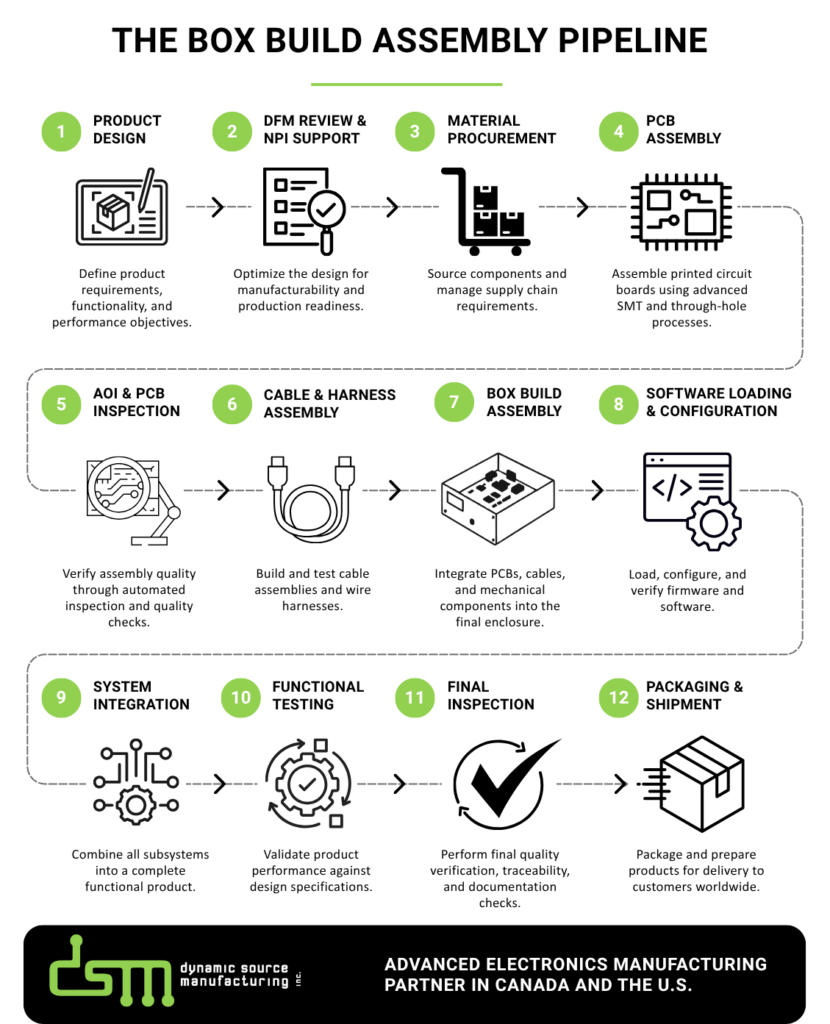
Box build assembly refers to the integration of printed circuit boards, mechanical components, cables, wire harnesses, displays, power supplies, enclosures, software, and other subassemblies into a finished electronic system. Depending on the application, a box build may range from a simple enclosure assembly to a highly complex electromechanical product requiring extensive testing, configuration management, and traceability.
Today, box build manufacturing plays a critical role in industries such as communications, industrial technology, aerospace, defence, energy, medical devices, and automotive electronics, where reliability and consistency are essential.
What Is Included in a Box Build Assembly?
The scope of box build services varies by product, but typically includes:
- Mechanical assembly
- Cable and wire harness integration
- Subassembly integration
- Power supply installation
- Display and HMI integration
- Software loading and configuration
- Functional testing
- System-level verification
- Product labeling and serialization
- Final packaging and shipment preparation
Many OEMs also require environmental testing, conformal coating, burn-in testing, revision control, and complete product traceability as part of the manufacturing process.
The complexity of these requirements often determines whether a contract manufacturer can successfully support long-term production.
Why Box Build Assembly Is More Complex Than PCB Assembly
Many OEMs underestimate the operational complexity associated with final product integration.
While PCB assembly focuses on component placement and soldering processes, box build manufacturing introduces additional variables including mechanical tolerances, multiple supplier components, firmware revisions, assembly sequencing, cable routing, and final product testing.
Without strong manufacturing controls, these variables can lead to:
- Increased defect rates
- Product configuration errors
- Longer production lead times
- Higher warranty costs
- Delays during new product introductions
Successful box build manufacturing requires close collaboration between manufacturing engineering, supply chain, quality, production, and program management teams.
The Importance of Design for Manufacturability (DFM)
One of the most overlooked contributors to successful box build assembly is Design for Manufacturability (DFM).
Engaging manufacturing engineering early in the product lifecycle helps identify risks before production begins.
Examples include:
- Optimizing enclosure designs for assembly efficiency
- Reducing cable routing complexity
- Standardizing hardware components
- Improving serviceability
- Simplifying test procedures
- Reducing assembly touchpoints
Addressing these issues during development can significantly reduce manufacturing costs while improving product reliability and scalability.
Supply Chain Management and Security of Supply
Modern electronic products often contain hundreds or thousands of components sourced globally.
A capable EMS provider must manage:
- Component procurement
- Lifecycle monitoring
- Alternate component qualification
- Inventory management
- Forecasting
- Supplier quality management
As supply chains continue to evolve, OEMs increasingly seek turnkey manufacturing partners capable of managing both production and material sourcing under a single operational framework.
This reduces risk while providing greater visibility into product availability and lead times.
What OEMs Should Look For in a Box Build Manufacturing Partner
Selecting a box build manufacturing partner should involve more than comparing pricing.
Key capabilities to evaluate include:
Manufacturing Engineering Support
Strong engineering resources help accelerate product launches, improve manufacturability, and resolve production challenges quickly.
Quality Management Systems
Look for disciplined quality processes, documented procedures, corrective action systems, and continuous improvement programs.
Production Scalability
The ability to support prototypes, low-volume production, and high-volume manufacturing within the same organization reduces transition risk as products grow.
Traceability and Process Control
Advanced manufacturing systems provide visibility into materials, production history, testing results, and product configurations.
Program Management
Dedicated program management helps align engineering, procurement, manufacturing, and customer requirements throughout the product lifecycle.
Why OEMs Are Moving Toward Turnkey Manufacturing
Many OEMs are consolidating suppliers and moving toward turnkey manufacturing models.
Rather than managing separate vendors for PCB assembly, cable assemblies, final integration, testing, and logistics, companies increasingly prefer a single manufacturing partner capable of managing the complete process.
Benefits include:
- Faster product launches
- Improved quality control
- Reduced supply chain complexity
- Greater operational visibility
- Lower total cost of ownership
For complex electronic products, the efficiencies gained often outweigh the perceived cost savings of managing multiple suppliers.

Choosing the Right Box Build Manufacturing Partner
As electronic products become more sophisticated, box build assembly has evolved into a strategic manufacturing capability rather than a simple assembly service.
OEMs evaluating electronics manufacturing services providers should look beyond production capacity and focus on engineering expertise, quality systems, supply chain management, process control, and long-term scalability.
The right box build manufacturing partner can help reduce risk, improve product quality, accelerate time-to-market, and support growth throughout the product lifecycle.
Reach out to DSM today: dsmsales@dynamicsourcemfg.com
Book a facility tour: Contact DSM