
Industry 4.0 Explained in Practice
What Does Modern Manufacturing Really Look Like on the Production Floor?
Industry 4.0 has become one of the most talked-about concepts in manufacturing. It is often associated with automation, robotics, artificial intelligence, and connected factories. While these technologies are important, Industry 4.0 is about much more than equipment. It is about creating an integrated manufacturing environment where technology, data, and people work together to improve quality, efficiency, traceability, and decision-making.
At Dynamic Source Manufacturing (DSM), Industry 4.0 is not a future vision. It is part of how we operate every day.
At its core, Industry 4.0 combines connected systems, automation, robotics, data visibility, artificial intelligence, and continuous improvement practices to create smarter and more responsive manufacturing operations. The real value does not come from the technology itself, but from how those technologies are integrated into processes that improve manufacturing outcomes.
Smart Manufacturing Starts With Automation
Automation plays a critical role in modern electronics manufacturing. As product complexity increases and quality expectations continue to rise, manufacturers must find ways to improve consistency, efficiency, and throughput without sacrificing flexibility.
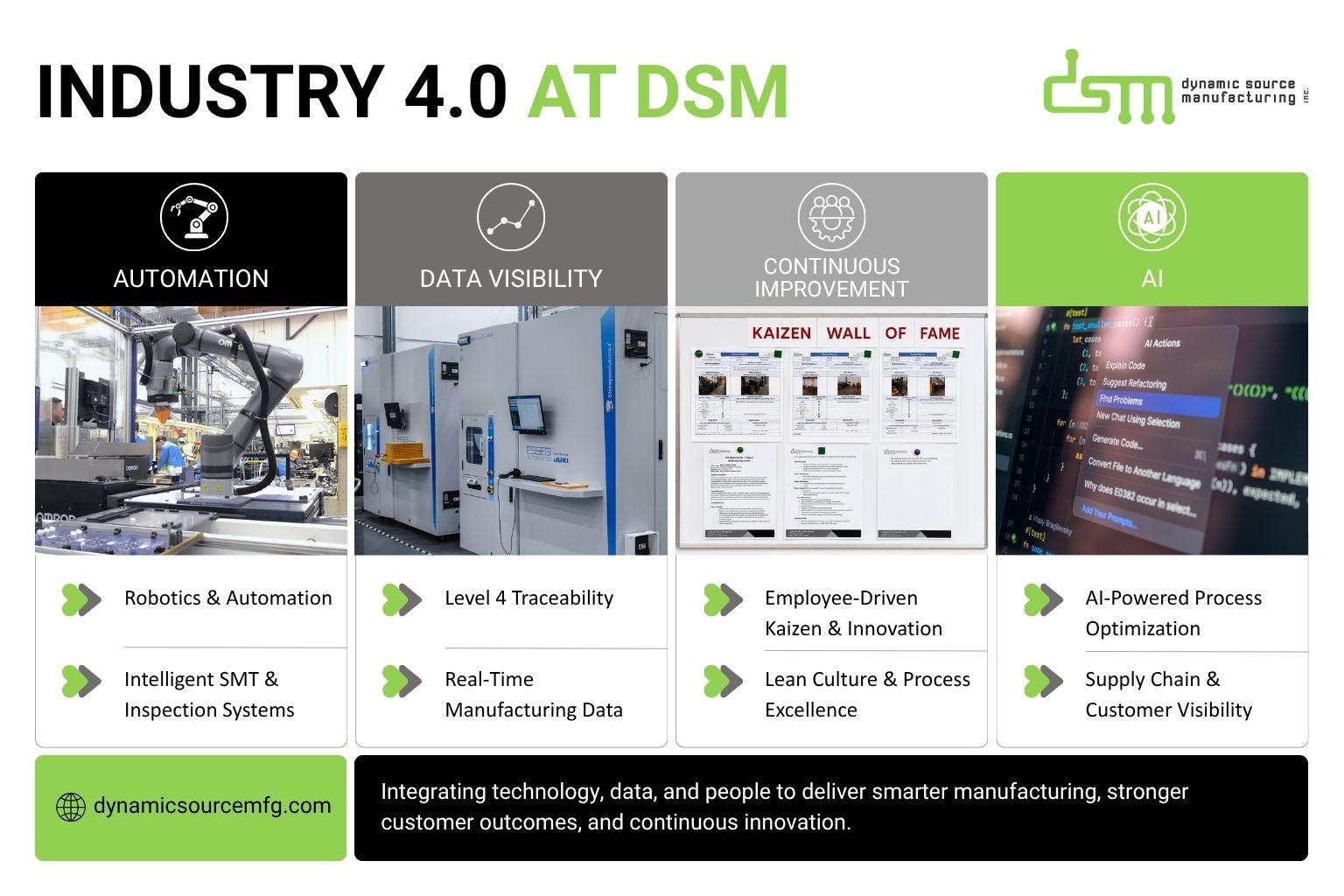
At DSM, automation is integrated throughout the manufacturing process through advanced SMT placement equipment, automated inspection systems, intelligent material management, and real-time production controls.
One example is our automated screw fastening technology. Previously, this process required significant manual involvement and operator time. Today, dual-platform automated fastening systems perform the same task with greater consistency and efficiency. While one board is completing its cycle, the next board is already being prepared for processing. The result is a measurable reduction in cycle time, improved throughput, and consistent torque and alignment across every assembly.
The objective of automation is not simply to replace manual work. It is to create a more reliable, scalable, and efficient manufacturing environment capable of delivering consistent results across increasingly complex products.
Industry 4.0 Is Also About Better Data
Automation is only one part of the Industry 4.0 equation. Equally important is the ability to capture, manage, and utilize data throughout the manufacturing process.
At DSM, intelligent material storage systems such as Juki Smart Storage Towers play an important role in supporting inventory visibility, material traceability, and production planning. These systems provide real-time inventory management, controlled storage conditions, and accurate tracking of components throughout the manufacturing process.
This level of visibility helps reduce material shortages, improve inventory accuracy, and support stronger production planning. It also enhances traceability by ensuring materials and assemblies can be tracked throughout production, supporting both quality management and customer requirements.
As manufacturing environments become increasingly data-driven, access to accurate and timely information allows teams to make faster decisions, improve operational control, and maintain high levels of manufacturing performance.
Technology Alone Is Not Enough
One of the biggest misconceptions about Industry 4.0 is that technology alone creates innovation.
In reality, the most successful manufacturing organizations combine technology investments with a culture that encourages continuous learning and improvement.
At DSM, one of our core values is Continuously Learn and Improve. We believe innovation does not only come from equipment, software, or automation projects. Some of the most impactful improvements originate from the people working closest to the process every day.
Our Kaizen Wall of Fame recognizes employee-driven improvement initiatives that enhance efficiency, quality, safety, and workflow performance. A recent example involved improvements to the reusable packaging area, where team members developed a more structured storage system that improved material accessibility, increased organization, and reduced wasted motion. While relatively simple in concept, the impact on workflow efficiency and consistency was immediate.
This combination of employee engagement and continuous improvement helps ensure that innovation becomes part of the culture rather than a standalone initiative.
The Next Phase: AI in Manufacturing
Artificial intelligence is quickly becoming the next evolution of Industry 4.0.
At DSM, we continue exploring opportunities to leverage AI across program management, operational workflows, and cross-functional business processes. We are also investing in company-wide AI training initiatives designed to help employees understand and apply AI tools in practical ways that improve efficiency, productivity, and decision-making.
Looking ahead, AI has the potential to improve information access, streamline communication, automate routine administrative tasks, and provide greater visibility into manufacturing and supply chain performance. These capabilities can help teams make faster, more informed decisions while creating a more connected operational environment.
As with every Industry 4.0 initiative, the objective remains the same: using technology to create meaningful value for customers and employees alike.

From Technology Investments to Customer Results
Industry 4.0 is often described through technology, but its true impact comes from how technology, data, people, and processes work together.
At DSM, advanced automation, intelligent manufacturing systems, real-time data visibility, employee-driven continuous improvement, and emerging AI capabilities all contribute to a smarter manufacturing environment. These investments help improve quality, strengthen traceability, increase efficiency, and support the evolving needs of our customers.
As a North American electronics manufacturing services provider, DSM continues to invest in Industry 4.0 principles across its operations to deliver advanced PCB assembly, box build integration, testing, supply chain management, and new product introduction services for customers across industrial, telecommunications, aerospace, defence, medical, energy, and other high-reliability industries.
The technologies will continue to evolve, but the goal remains unchanged: delivering better manufacturing outcomes through innovation, continuous improvement, and operational excellence.
Reach out to DSM today: dsmsales@dynamicsourcemfg.com
Book a facility tour: Contact DSM